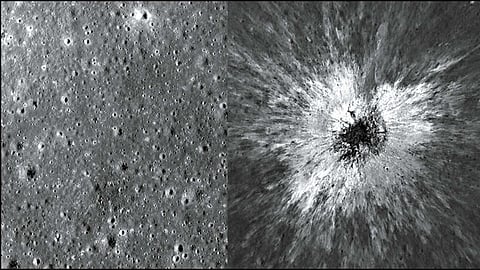
NASA’s Lunar Reconnaissance Orbiter (LRO) has discovered a newly formed crater on the Moon that is about 728 feet (222 metres) wide and 141 feet (43 metres) deep. The crater was created when an asteroid or comet, estimated to have been about the size of a three- to six-story building, crashed into the Moon between April 11 and May 22, 2024. Scientists have named the crater McGetchin, and NASA says an impact of this size may happen on the Moon only about once in a century or even less often. The LRO’s instruments also detected a cold area around the crater that is about 4 miles (7 kilometres) wide. At night, this region is around 16 degrees Fahrenheit (9 degrees Celsius) colder than the surrounding surface because the impact disturbed and loosened the Moon’s soil, making it less able to retain heat. The discovery is important because it shows that a large impact can change the Moon’s surface far beyond the crater itself. NASA’s LRO has been studying the Moon since 2009 and has helped scientists understand its surface, temperatures, craters, and possible water-ice deposits.