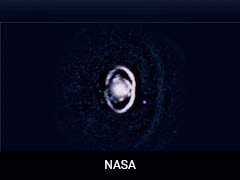
In a remarkable breakthrough, astronomers have successfully captured direct images of a young planet, WISPIT 2b, which is forming within a gap in a protoplanetary disk surrounding a star. This represents the first instance in which scientists have verified the existence of a planet in one of these disk gaps, which have long been theorized to be formed by the planets themselves as they grow. As reported by NASA, WISPIT 2b is a substantial gas giant, approximately five times the mass of Jupiter and merely five million years old—nearly 1,000 times younger than Earth. It orbits a young star known as WISPIT 2, situated about 437 light-years away from our planet. Protoplanetary disks, composed of gas and dust, encircle young stars and serve as the nurseries for new planets. The gaps that form within these disks often manifest as dark rings, and scientists have posited that the planets developing within the disks are responsible for creating these voids. Until this discovery, however, no planet had been directly observed within one of these gaps. The finding was achieved through the use of cutting-edge imaging technology. The star and its surrounding disk were initially observed with the Very Large Telescope (VLT) located in Chile. Subsequently, astronomers employed the MagAO-X instrument on the Magellan Clay Telescope to obtain a direct image of WISPIT 2b in Hydrogen-alpha light. This specific type of light is emitted when hydrogen gas descends onto a developing planet, indicating active formation. According to NASA, WISPIT 2b was discovered by a team led by Laird Close, an astronomer from the University of Arizona, along with Richelle van Capelleveen, an astronomy graduate student at Leiden Observatory in the Netherlands. This discovery followed the recent identification of the WISPIT 2 disk and ring system, which was also led by van Capelleveen.