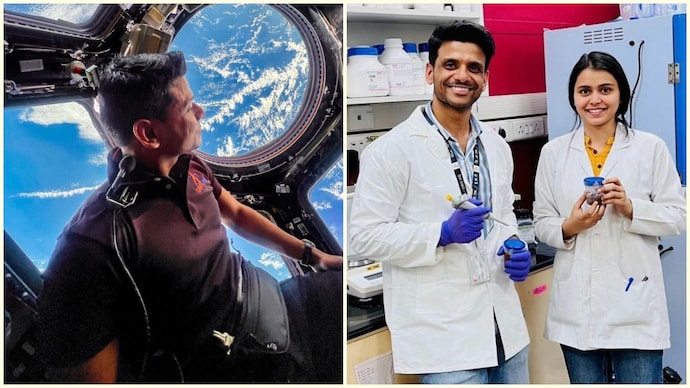
Indian astronaut Shubhanshu Shukla has achieved an important milestone in his career by contributing to a new scientific study. Shukla is a co-author of a research paper that studies how bacteria behave in Mars-like soil and how they can help build strong and sustainable structures on Mars. The study was led by scientists from the Indian Institute of Science (IISc) and published in the international journal PLOS One. One of the biggest challenges for future Mars missions is construction. Carrying building materials from Earth is costly and difficult. Scientists are therefore exploring ways to use materials already available on Mars. Earlier studies showed that some Earth bacteria can turn soil into brick-like materials. However, Martian soil contains perchlorate, a toxic chemical that can be harmful to living organisms. This raised questions about whether bacteria could survive and work in such conditions. In earlier experiments, researchers used a bacterium called Sporosarcina pasteurii to create “space bricks.” This bacterium produces calcium carbonate, which binds soil particles together. Guar gum, a natural substance from guar beans, helped the bacteria survive and strengthened the bricks. In the new study, scientists tested a stronger bacterial strain found in Bengaluru’s soil. They exposed it to perchlorate to see how it would react.
Surprisingly, although perchlorate slowed bacterial growth and caused stress, it helped produce stronger bricks. Under stress, the bacteria clumped together and released more protective material, which improved soil bonding. Tests showed that bricks made with perchlorate, guar gum, and other additives were stronger than those made without perchlorate. Researchers say this finding could be very useful for future space missions. Shukla, who is studying at IISc while training as an astronaut, believes using local resources on the Moon and Mars can reduce costs and improve safety. He points out that uneven terrain has already caused problems for landers. The study is Shubhanshu Shukla’s first published scientific research and shows how Indian astronauts are contributing not only to space missions but also to the science that will support human life beyond Earth.